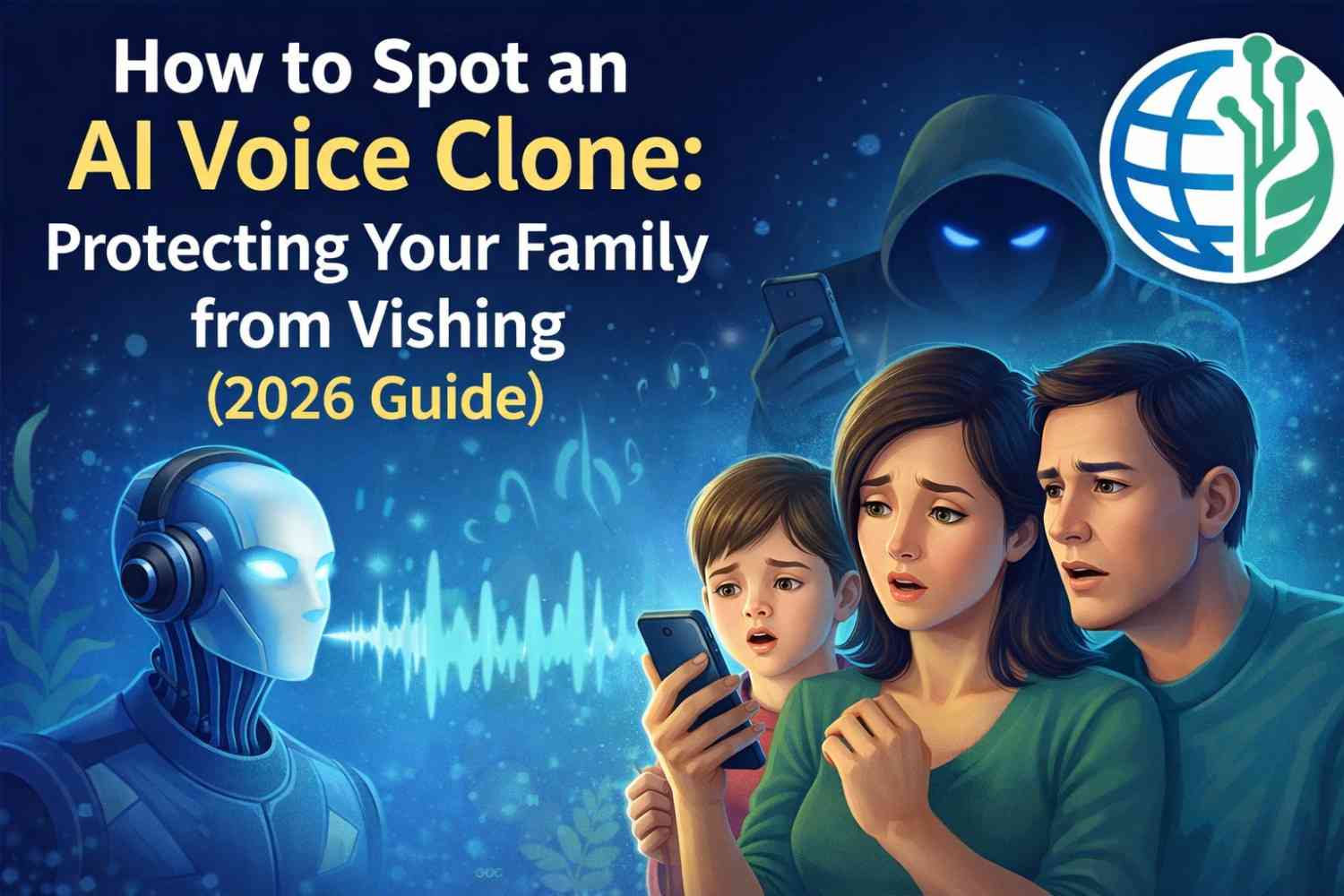
It only took three seconds. That is all the time a scammer needs from a stray TikTok video, an Instagram Reel, or a LinkedIn webinar to clone your daughter’s voice with terrifying precision. Imagine receiving a call: it sounds exactly like her, crying, claiming she’s been in a car accident or detained, and begging for money.
This isn’t a scene from a sci-fi movie; it is the reality of Vishing (Voice Phishing) in 2026. Experts at TechNewzTop360 explain that as artificial intelligence has moved from experimental to “hyper-realistic,” the traditional “red flags” of scams have vanished. According to the latest 2026 CrowdStrike Global Threat Report, AI-powered cyber attacks have surged by 89% year-over-year, with vishing specifically seeing a massive spike as breakout times—the time it takes a hacker to move from initial contact to a successful heist—have dropped to under 30 minutes.
In this guide, we will move beyond the fear and provide you with a “Human Firewall” protocol to protect your loved ones from the most sophisticated financial predators of our time.
What Is AI Voice Cloning?
To defend against a threat, you must understand how it works. In 2026, the technology has evolved from simple “text-to-speech” into deep-learning neural synthesis.
How the Technology Works
Modern AI uses Neural Speech Synthesis. Unlike old systems that spliced together pre-recorded words, these AI models learn “vocal biomarkers”—the unique way you pronounce “R’s,” the slight breathiness of your vowels, and your specific pitch contours. This is similar to how a new software name might use AI to automate complex data analytics. By analyzing a small sample, the AI creates a mathematical model of your voice that can say anything the attacker types into a console.
Why 2026 is Different: Real-Time Conversion
The biggest shift this year is the transition to Real-time Voice Conversion (Speech-to-Speech). In the past, a scammer had to type text and wait for the AI to generate audio. Now, a scammer can speak into a microphone, and the software transforms their voice into yours in less than 100 milliseconds.
The Source of the Data
Scammers no longer need to record you secretly. They “scrape” public data. Your “Year in Review” video on Facebook or your corporate “Introduction” video on YouTube provides more than enough high-fidelity audio for a perfect clone. Always be wary of unofficial communications; for instance, many users wonder if securityfacebookmail.com is real or a scam when receiving unexpected security alerts.
Why Vishing is a Top Threat in the USA
The United States has become the primary target for these operations due to the high volume of digital payment apps and a large aging population with significant savings.
- The FBI Warning: The FBI’s IC3 (Internet Crime Complaint Center) issued a critical 2026 alert regarding “AI-Enhanced Virtual Kidnapping.”
- Financial Impact: Deloitte predicts that generative AI could enable fraud losses to reach $40 billion in the United States by 2027.
- Target Demographics: While anyone can be a victim, scammers prioritize elderly parents and high-level executives (CEO Fraud).
12 Warning Signs of an AI Voice Clone (2026 Checklist)
If you receive an urgent call, look for these technical “artifacts” that AI still struggles to perfect:
- Processing Lag: Look for a consistent 0.5 to 1-second delay before the caller answers.
- Mismatched Background: The caller says they are in a “windy street,” but the noise sounds looped.
- The “Monotone Slip”: AI often returns to a flat, robotic cadence in long sentences.
- Lack of Natural Breathing: Humans take breaths; AI often forgets to simulate the sound of an inhale.
- Refusal to Move to Video: Scammers avoid visual verification. Note that while some issues are technical, like a winobit3-4 software error, in this case, it’s a deliberate tactic.
- Unusual Slang: Formal language instead of casual family talk.
- Odd Syllable Emphasis: Mispronouncing family nicknames.
- Repetitive Emotional Loops: Repeating “Please help me” with the exact same pitch.
- Untraceable Payments: Demands for Crypto, Apple Gift Cards, or Zelle.
- Number Spoofing: Appearing as your own home phone number.
- Evasive Contextual Memory: AI cannot answer deep personal questions.
- The “Hang-Up” Test: Scammers get aggressive if you try to hang up.
AI vs. Human: The 2026 Comparison Table
| Feature | Human Voice | AI Voice Clone (2026) |
|---|---|---|
| Breathing | Inconsistent, audible inhales | Often perfectly “breathless” |
| Emotion | Dynamic and reactive | Sometimes flat or “looped” |
| Background | Organic & changing | Static, muted, or looped |
| Reaction Time | Instant | 0.5s – 1s “Processing” lag |
The “Family Safe Word” Protocol
The most effective defense in 2026 is a low-tech solution: The Family Safe Word.
- How to Choose a Phrase: Use a “nonsense phrase” like: “The blue penguin flies at midnight.”
- The Silent Rule: Teach your family to never speak first when answering an unknown number.
- Implementation: Sit down with grandparents and explain this as a “Family Security Code.”
Advanced Verification Steps
If you are unsure, ask a question that isn’t publicly available. Always remember that browser-based attacks often rely on similar social engineering tactics to succeed.
The Direct Callback: This is the golden rule. Hang up. Then, call the person back using the number saved in your contacts. Never trust the “incoming” caller ID.
What to Do If You’ve Been Targeted
If you realize you’ve shared information or sent money:
- Immediate Account Freeze: Call your bank and payment apps (Zelle, Venmo) immediately.
- USA Reporting: File a report at ReportFraud.ftc.gov and the FBI’s IC3.gov.
- FCC Legal Update: Under the 2026 FCC ruling, AI voices in robocalls are officially “artificial” and violators can be fined up to $23,000 per call.
Conclusion: Awareness Over Fear
The goal of scammers is to use your love for your family against you. However, an informed family is an un-scammable family. By implementing a Safe Word, understanding the Technical Red Flags, and following the Direct Callback rule, you can turn your home into a fortress.
Your Next Step: Talk to your family tonight. Choose your Safe Word. Share this guide to ensure your friends and neighbors are protected.
Frequently Asked Questions (FAQ)
Yes. In 2026, advanced “zero-shot” neural models can analyze just three seconds of high-quality audio—often harvested from social media stories or TikToks—to create a nearly perfect vocal clone. This clone can then be used in real-time “speech-to-speech” software to conduct live phone conversations.
While the technology itself has legal uses (like in filmmaking), using AI voice clones for fraud or extortion is a serious federal crime. Additionally, as of 2024/2026, the FCC has officially ruled that AI-generated voices in unsolicited robocalls are illegal under the Telephone Consumer Protection Act (TCPA).
The most reliable technical signs are “processing lag” (a short delay before the AI responds) and a lack of natural breathing sounds. However, the best defense is the “Direct Callback” method: hang up and call your loved one back on their known, saved phone number.
A Family Safe Word is a pre-arranged “nonsense phrase” (e.g., “The blue penguin likes tacos”) known only to your inner circle. If you receive an urgent call from a loved one asking for money or help, ask them for the safe word. If they cannot provide it, it is likely an AI scam.
If you have been targeted by a vishing scam, you should immediately report the incident to the Federal Trade Commission (FTC) at ReportFraud.ftc.gov and the FBI’s Internet Crime Complaint Center (IC3) at ic3.gov. These agencies track the digital wallets and phone numbers used by scammers to prevent future attacks.